
Florence Cathedral (Santa Maria del Fiore)
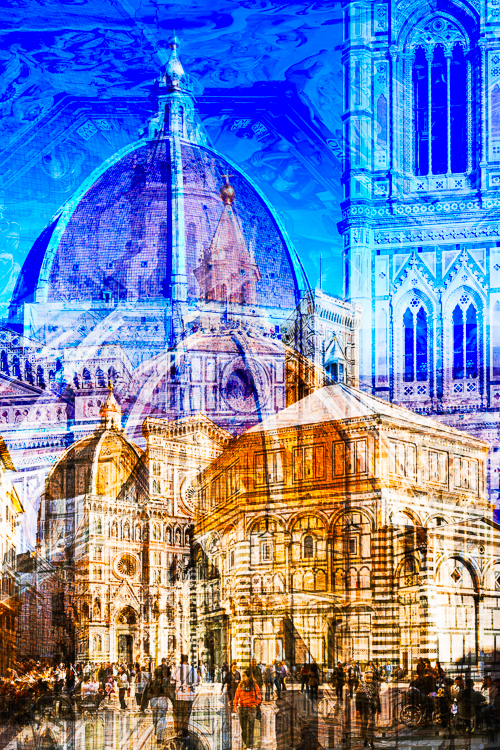
For my series of sacred “Multiperspective” collages, I really wanted to photograph Florence Cathedral Santa Maria del Fiore in Florence – it is historically and in terms of architectural history related to the shots from Lucca, Siena and Pisa. At the beginning of November 2025, I had time, and the weather was forecast to offer plenty of sunshine, with autumnal temperatures still between 10 degrees at night and up to 20 degrees during the day. Even if you can’t comfortably sit on the outdoor terraces of bars and restaurants in the evening, the temperatures are quite pleasant for extended tours of the city. My last stay 15 years ago was in 36-degree summer heat – unbearable during the day.
There used to be a small campsite next to Piazzale Michelangelo, close to the city and directly at the beautiful viewpoint above the city. The site was small, cramped, on a steep slope, and more suitable for tents than camping vehicles. I once stayed there during my first trips to Tuscany in 1988/89. At some point, it no longer met current demand and was then closed. As an alternative, there is now the modern ‘hu’ campsite. It is located about 3 km east of the city centre on the Arno, has flat, spacious pitches, is open all year round, and is optimally connected to local transport. Bus line 14 between Santa Maria Maggiore and Il Girone runs several times an hour, stops directly at the campsite, and takes about 15 minutes depending on traffic. This allowed me to easily get into the city with all my camera equipment. As an early riser, the bus line also offered me an early connection for a city tour at dawn.
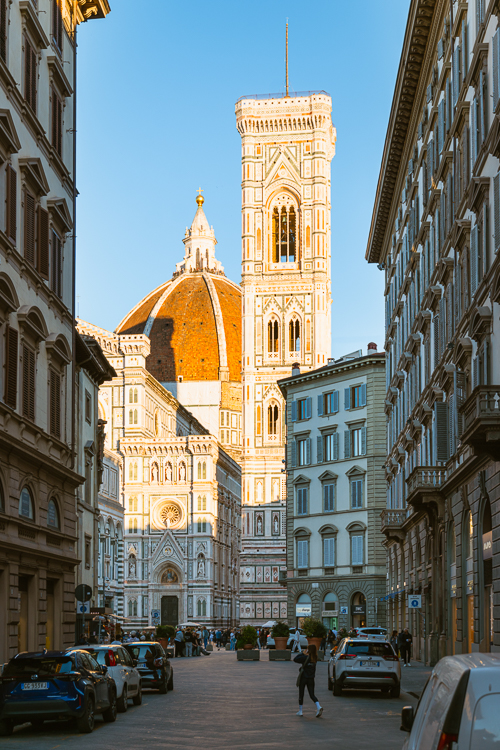
My first approach to the Cathedral was directly after arrival, in the early afternoon. After the short bus ride, I walked through the narrow streets of the old town. Suddenly, the facade of the Cathedral appeared in the line of sight of a street, towering over all surrounding buildings and reflecting the warm evening sun into the shady street. Here, one could already glimpse the enormous dimensions of the building, after all, Europe’s fourth-largest church. However, I got an optimal impression of the massive scale of the building group consisting of the Baptistery, bell tower (Campanile), and nave with the dome from above.
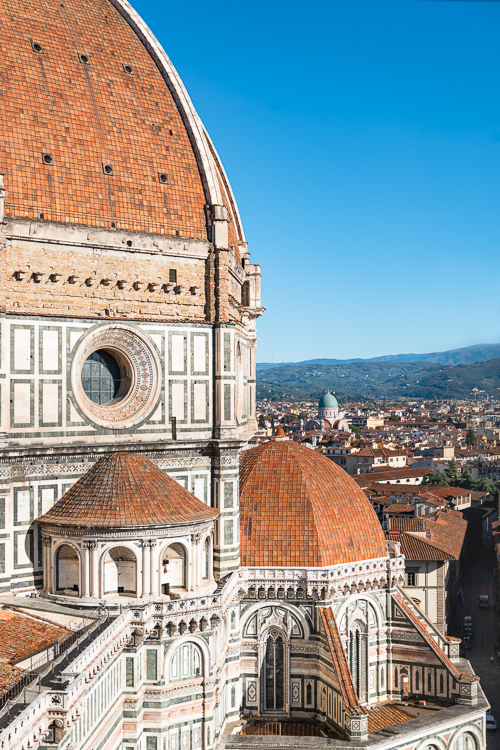
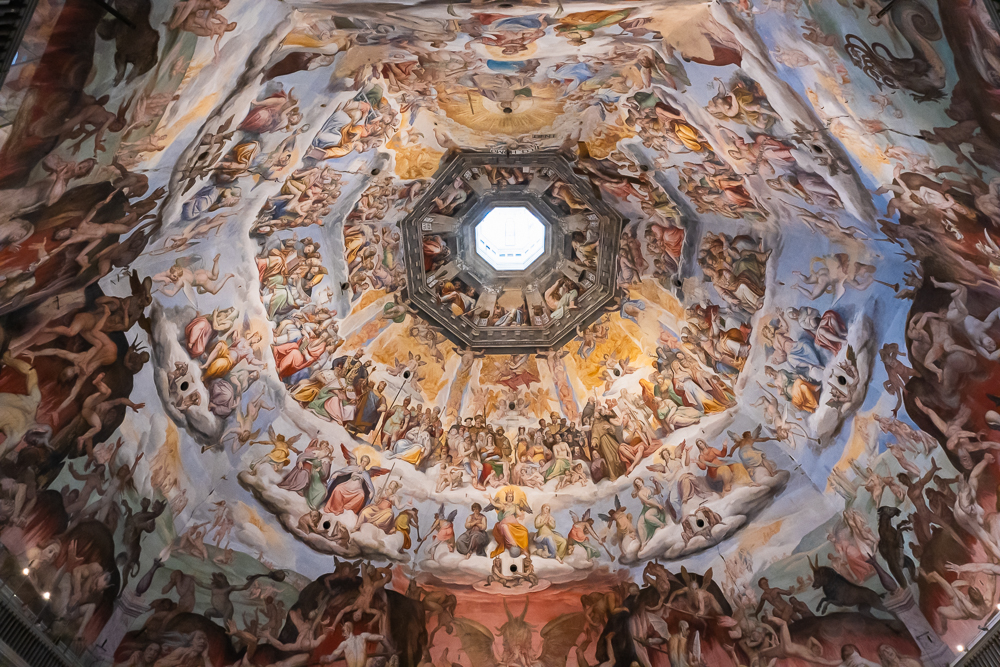
The viewing terrace of Piazzale Michelangelo on the other side of the valley was one such place and showed how the Cathedral dominates the city’s skyline. An ascent of the Campanile was recommended to admire the details of the nave’s facade and the dome’s soaring curvature from up close. The ascent of the dome itself revealed the closest view of the enormous fresco inside, and in the staircase within the double-shelled dome walls, an insight into the masterful construction technique. Of course, the view over the entire city alone was worth the more than 400 steps and 100 metres in height.
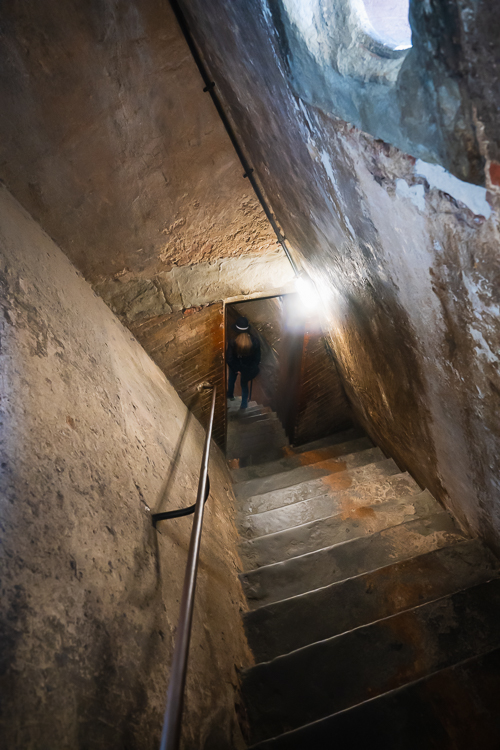
For the dome tour, a ticket must be booked in advance for a specific day and time, as the number of people is limited for safety reasons and space on the narrow staircase. The duration is also limited to 45 minutes. From autumn to spring, an ascent at sunset in the early evening is even possible within opening hours. While booking in advance is not required for the Campanile, and there is no time limit, longer queues and waiting times can be expected at special times, such as sunset.
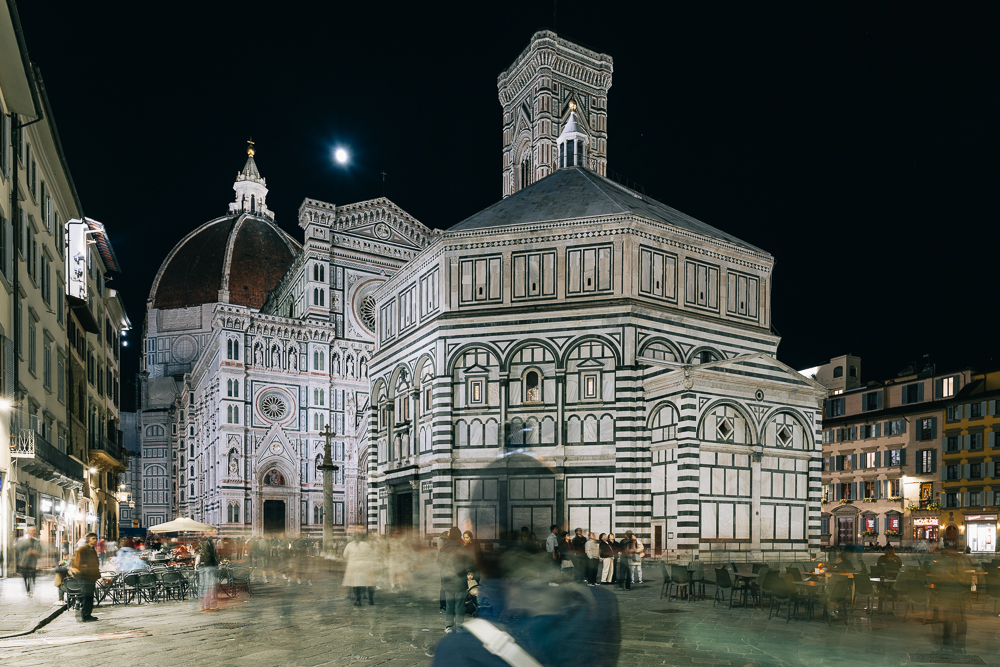
While magnificent cathedrals and churches were already being erected elsewhere in Tuscany – Pisa, Siena, Lucca – in the 11th century, Florence only had the Basilica di San Lorenzo and the Baptistery, as well as the predecessor church of today’s Cathedral, Santa Reparata. To surpass these structures, construction of the Cathedral began at the end of the 13th century.
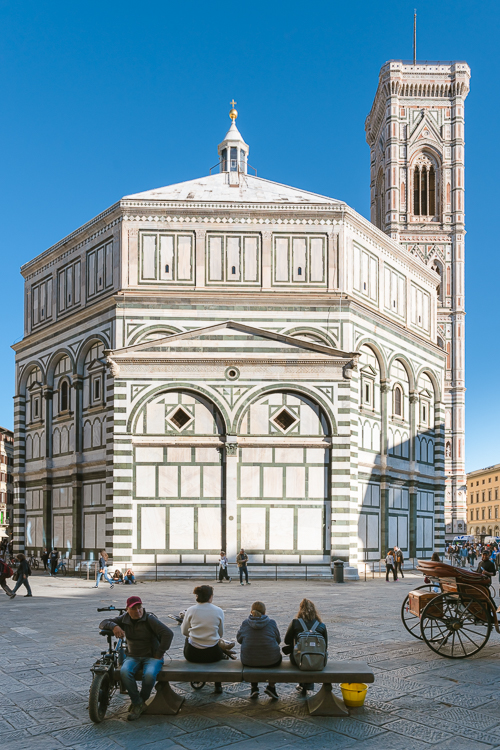
The ensemble combines many architectural styles and art periods due to its centuries-long construction period. In the underground, foundations, cobblestones, or mosaics dating back to the Romans can be found. The Baptistery is classified as Romanesque in style, but due to its resemblance to ancient buildings and ornamental marble cladding, it is also referred to as a representative of the Pre-Renaissance. The bell tower and the Cathedral itself are Gothic. Some of the most significant architects, sculptors, painters, and artists of their time were involved in its construction, e.g., Arnolfo di Cambio, Filippo Brunelleschi, Giorgio Vasari, Giotto di Bondone or Lorenzo Ghiberti.
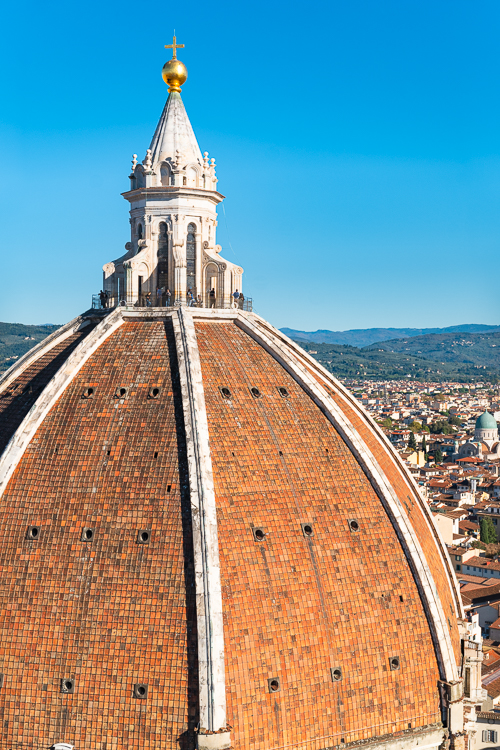
The proverbially most outstanding element of the Cathedral is its enormous dome. It was intended to surpass all previous ones and represent the city’s re-emerging power and significance. The diameter of the vault is 42 m and it sits at a height of 52 metres, making it the widest and highest dome ever built. This presented the architect Brunelleschi with several technical, financial, and static challenges, which were solved with innovative approaches. Thus, he completed a Gothic-planned structure with ideas, techniques, and individual elements at the transition to the Renaissance. Brunelleschi later completed his first true Renaissance building with the conversion of the medieval church Basilica di San Lorenzo in the Cathedral’s neighbourhood.
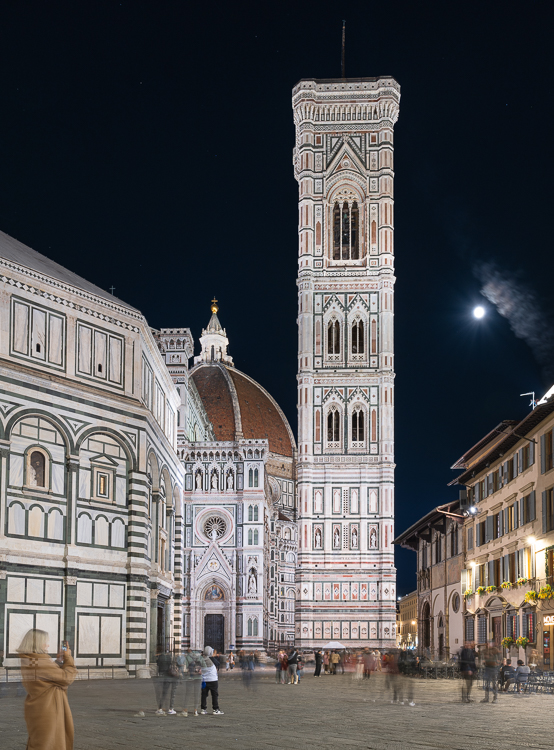
To get the most diverse compositions and lighting moods or to account for the shadows cast by surrounding buildings and the incidence of light, I returned at different times. When a near full moon with its bright, silvery light at night complemented the clear Mediterranean daylight, I found ideal creative conditions.


Leave a Reply
Want to join the discussion?Feel free to contribute!