
 My photographic work is influenced by images designed for book or magazine layouts and travel reports; as such, I tend to take standalone individual shots, often using a reportage style or working with graphic structures, surfaces, and colours. Such shots are better suited for use as a print, cover, background, or illustration rather than for a multi-image slide show. I enjoy the freedom regarding format and cropping—for example, for panoramas or square images—moving away from the classic 3:2 or screen formats like 4:3 or 16:9. Very often, a picture gains even more in post-processing—due to the choice of crop or the rotation of the lines; for many famous photographers, critical and creative lab staff played a decisive role in the final result.
I am more of a ‘picture taker’ than a ‘picture maker’. An image usually depends on the circumstances given while travelling, which are often limited or unchangeable—the available time, the light and weather, the vantage point and perspective, the behaviour of people or moving objects, etc.—to get the best out of the composition. I have rarely been lucky enough to be able to wait for the right weather, such as on the New Zealand west coast of the South Island with the ‘Mirror Lake’.
Cameras, regardless of type or class, are tools for me. In terms of content, it was often irrelevant for a good picture whether it was taken with a disposable or an expensive SLR camera—though in technical categories like resolution, sharpness, and the like, things naturally look different. I started snapping with simple cameras as a child, e.g. Revue400S, Ricoh-AD1. From the 1990s into the digital age, I first photographed with a Minolta (I seem to remember the X-300) and later with a Nikon FE 2, and more recently with digital cameras such as a Lumix LX3 and a Nikon D600 or the Z8. For choosing digital cameras, I recommend the very detailed tests, comparisons, and reviews from dpreview.
 In the analogue world, I felt that the camera is primarily the housing for the film, where certain functions and controls for exposure are located. But the lens influences the image much more; that is where decisive parameters like focal length or aperture are set. The best body is useless if the lens is no good—even in the digital age. Nowadays, the camera sensor has been added as a decisive element, which used to be the film—resolution, light sensitivity, dynamic range, and sharpness. I also wouldn’t want to be without modern exposure metering and autofocus anymore, as their support allows for a stronger focus on the subject and the composition.
The image has to go through the lens. I often used a 28–85 mm lens with a medium maximum aperture, which served as my standard lens. Nowadays, I also like to use the 50 mm prime lens with an f/1.8 aperture, which allows for a shallow depth of field and a beautiful bokeh, for example. In the telephoto range, it is worth investing in a fast lens; here, the Nikon 80–200 mm with a constant aperture of f/2.8 served me well for many years before I had to replace it with its successor, the 70–200 mm, after a fall. The price for this is the high weight, but this is more than outweighed by more leeway with the aperture value, e.g. to still take handheld shots without camera shake.
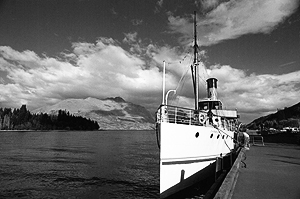 However, I was absolutely thrilled by the compact 20 mm wide-angle lens with an f/2.8 aperture that I acquired in 1997. With its 90-degree angle of view, great compositions could be formed, such as panoramas or people in rooms; I didn’t want to be without it on my travels back then. Nowadays, I only use it on ski and mountain tours when weight is relevant. Otherwise, I have replaced it with the excellent Nikon 14–24 mm zoom, which offers a massive improvement in imaging performance and creative options in terms of angle of view and sharpness, for example, but is correspondingly large and heavy due to the optics required.
A tripod often serves well; thanks to modern materials and mechanisms, some models offer a good compromise between stability and weight/size and are therefore well-suited for mountaineering and backpacking. Currently, I use a Sirui T2004x aluminium tripod with a K20x head for this, which represents a good compromise of functionality, robustness, and weight for tours and travel.
You can also tell from good pictures whether you have built a relationship with the person depicted or the subject in general—according to the ‘golden rule’ of reportage photography by Robert Capa: ‘If your pictures aren’t good enough, you’re not close enough.’—which doesn’t mean physical proximity. Besides Cartier-Bresson and Robert Capa, it is also worth looking at the works and attitudes of Ansel Adams, who captured magnificent natural landscapes, or the portraits of Annie Leibovitz. In recent years, influences from the likes of William Eggleston, Stephen Shore, Wolfgang Tillmans, and Edward Hopper have also come into play.
No matter what ‘tool’ you have, or who or what inspires you—try things out and have fun.
Leave a Reply
Want to join the discussion?Feel free to contribute!