
Hike to the summit of Sv. Ilija (961 m)

Sv. Ilija is the dominant peak of the long mountain ranges on the Pelješac peninsula and the surrounding South Dalmatian islands of Korčula, Mljet, Brač and Hvar. The karsic rock massif forms a high-contrast backdrop for the medieval old town of Korčula on the opposite island of the same name. Even if the mountain massif with its flanks rising steeply from the sea appears wild and inaccessible from a distance, the lower slopes are covered with orchards, olive groves or vines, which are replaced by macchia, scree and rocks at higher altitudes. In shadier valleys, hollows and high plateaus, even denser pine and fir groves can be found. The mountain ranges form a massive barrier for the cool northern winds and ensure a warm climate all year round on the southern coast of Pelješac.
 To prepare, I had picked up a hiking map from the tourist information office in Orebić. It is at a scale of 1:50,000 and quite useful. I then spent the night at the Franciscan monastery to enjoy the view over the islands by moonlight and to save myself the route from the campsite on the other side of Orebić to the monastery. As expected, the alarm clock woke me up at 2 am, and this time I didn’t oversleep . I climbed down the ladder from the roof tent and was suddenly wide awake – my shoes were gone. I had put them outside under the car during the night. Who steals old hiking boots, or was someone playing a nasty trick on me? I’m a light sleeper and hadn’t heard anyone during the short night. I set the headlamp to the highest setting and started searching the area around the car. There, about 15 metres away, lay the left shoe in the long grass. After a short time, the second shoe was also found in a different direction. The laces had apparently been bitten or chewed off. So animals had been at them; the “scent” was probably too tempting.
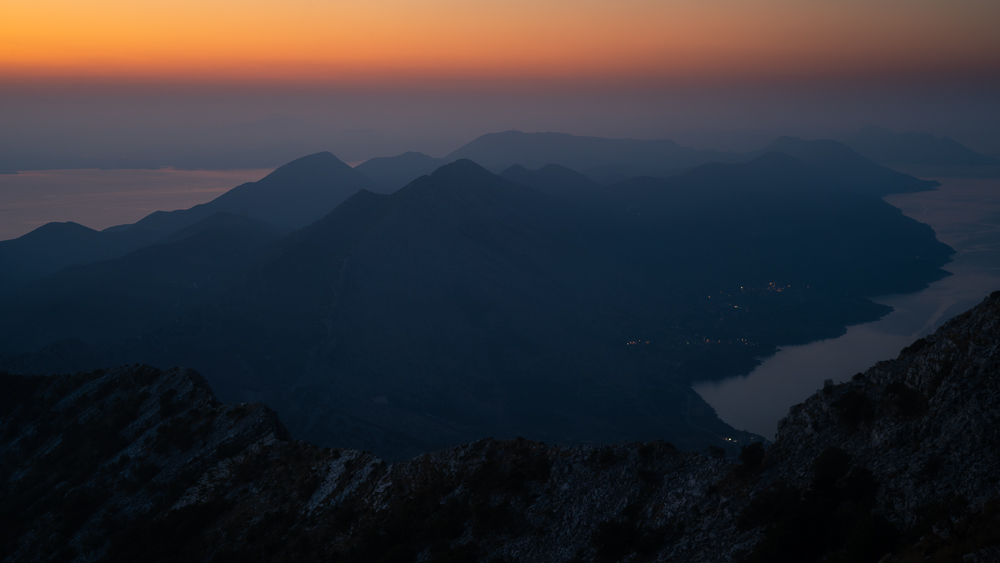 After the excitement was over, I could finally set off. The moon had already set and a magnificent starry sky was visible. First, I walked at the same altitude along the illuminated track to the hamlet of Bilopolje, where a path soon branches off to the right, quickly leaving the last houses behind and gaining height rapidly. This makes the nocturnal view over Korčula even more impressive. The night provided hardly any cooling, and the temperature still felt like it was over 25 degrees. Accordingly, I started to sweat. Soon I reached a ridge and the path turned northwards into a narrow valley section into the interior of the island and further into dense, dark pine forests, which absorb the light of the headlamp even at short distances.
 To the left and right of the narrow path I heard rustling and crackling – Pelješac is said to be home to the last jackals in Europe. In addition, mongooses were introduced in the past to combat sand vipers – so at least there is no longer any danger from the latter. After climbing eastwards through the forest for a while, the trees thinned out. Finally, at an altitude of about 800 metres, I reached a stone mountain hut where I took a break. Refreshed, I took on the last few metres of altitude over scree and rock to the summit of Sv. Ilija and stood by the stone pyramid with the summit cross (a new one, the old, weathered one was still lying next to it) as dawn broke.
 In the east, the peaks of the Biokovo mountains on the Makarska coast rose out of the haze, and my gaze wandered far over the islands of Hvar, Korčula and Mljet. After a while I got company; two men arrived just in time for the sunrise. One of them had a folding spade with him in addition to a headlamp and a rucksack for food and drinks – I wonder if that was intended as protection against wild animals? The descent from Sv. Ilija followed the ascent path back to the mountain hut. There I turned east, where the path leads through a forest hollow.
 After a short climb, I stand at a saddle above a rock step with an impressive view down to Orebić and Korčula. Over scree slopes and through light forest, the descent is steep but not difficult and not very exposed, leading down into a gorge that later opens up to the wooded slopes above Orebić. In gentle ups and downs through olive groves, orchards and vines, I cross back west to the monastery and pass the church of Gospo od Karmena (built in 1630), which is also worth seeing, before finally reaching my starting point at the Franciscan monastery.
So ends a wonderful circular tour, which was later followed by a relaxing and refreshing dip in the sea. With this further highlight of the journey along the Croatian Adriatic coast, the turning point was reached at the same time. With the last ferry crossing from Trpanj to Ploče on the mainland, I headed back north.
More pictures of Korčula in the Croatia gallery.


Leave a Reply
Want to join the discussion?Feel free to contribute!