
Rocks and Coves at Cap de Creus

The Cap de Creus peninsula marks the easternmost point of mainland Spain. Like a backbone, the eastern foothills of the Pyrenees meet the Mediterranean coast here. West of a line from El Port de la Selva to Roses, the coastal mountains separate Cadaqués and the Cap de Creus Natural Park from the rest of the Costa Brava. Until the construction of the only access road in the 19th century, Cadaqués was only accessible by sea. Numerous long-distance hiking trails, for example, along the main ridge of the Pyrenees to the Atlantic, begin or end here.
The landscape impresses with many bizarre rock formations and various types of rock: quartzites and slates in yellow, red, black, and grey hues. Magmatic rocks, formed millions of years ago by pressure and heat and wildly shaped by prolonged erosion, stimulate people’s imagination.
Barcelona-based travel writer Raymond Chandler says in his book “Us with Us” about Cadaqués: “What attracts artists is not only the light, but also the minerality, a combination of light, stone and water that produces a unique colour combination, and you can see that in the art created here“. Even places like Cadaqués and Portlligat have impressive rocky coastal sections within their town limits, interspersed with small bathing coves.
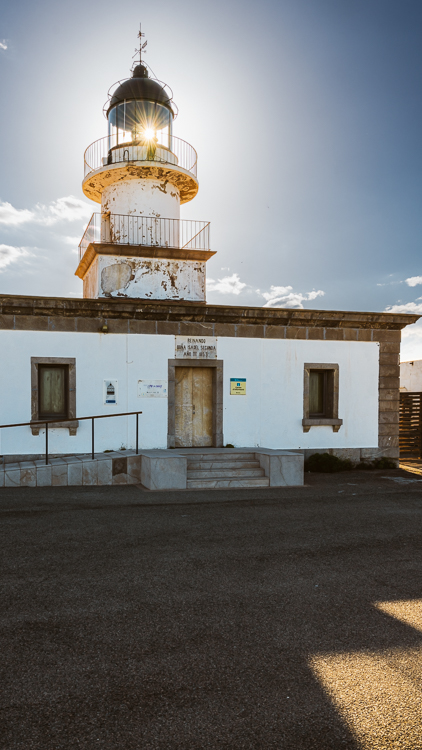
Although there’s a road leading to the lighthouse at the cape, it’s closed to private traffic during the day in the summer season. A public bus operates instead. I preferred to explore the cape by both bike and on foot anyway. With the Tramuntana wind, I was often exposed to strong gusts on the way to the lighthouse in the barren landscape – lots of bushes and only a few trees. That’s why I preferred hiking; the most beautiful rock formations and secluded coves, perfect for a break and a dip in the sea, can only be explored on foot anyway. I completely agree with Bruce Chatwin: “Man’s real home is not a house, but the Road, and that life itself is a journey to be walked on foot.”
The secluded, yet exclusive, location is both a curse and a blessing. Artists and hippies were the first to discover this then-poor region. Fortunately, there hasn’t been a tourist sell-out with its worst excesses, such as the construction of hotel complexes. Nevertheless, on some days, the access road is closed due to overcrowding in the town.


Leave a Reply
Want to join the discussion?Feel free to contribute!