
Cilento hiking classic on the ‘Sentiero delle quattre spiagge’
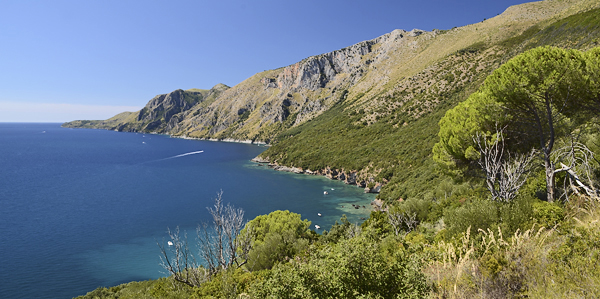
Between Marina di Camerota and Scario on the Gulf of Policastro, the Cilento coast is wild and dramatic. The coastal road winds its way up from Marina di Camerota in many hairpin bends via Lentiscosa into the hinterland, passing Monte Bulgheria before reaching the Gulf of Policastro again at Scario. Here, the mountains move right up to the sea, rising steeply over 500 m from the water: sun-bleached yellow grassy slopes, criss-crossed by a pattern of green macchia and karstic white rock ridges, stand in sharp contrast to the azure, steel blue and turquoise of the sea and a cloudless sky. Steep cliffs and rugged crags, hidden grottoes and small bays with pebble or sandy beaches alternate, with the crumbling ruins of former coastal watchtowers always in sight above them.
 This stretch of coastline is therefore best explored on foot or by boat. During the summer season, daily boat trips with stops at the beaches are offered from Scario and Marina di Camerota; there are also water taxis or the option to rent a boat yourself (since a licence is only required in Italy for engines over 40 hp, this is a great experience after a short briefing). In recent years, more and more old paths along the coast, to the mountain peaks or to the beaches have been marked as hiking trails. This means a hike can be combined with a boat trip to create an eventful circular tour with a wide variety of impressions.
 I therefore call the hike from Spiaggia Lentiscelle in Marina di Camerota via Cala Pozallo and Cala Bianca to Baia degli Infreschi the “Sentiero delle quattre spiagge”. Depending on how long you spend on the beaches, the approx. 4.5 km can be covered in about two hours of walking time (one way). This tour is described as a “Cilento hiking classic” in travel and hiking guides, and it more than lives up to that reputation.
From the first beach, Spiaggia Lentiscelle, I climbed through woods, olive groves, holiday homes and fields onto the first ridge in the hinterland of Monte Luna (though you never have to tackle more than about 80 metres in altitude at a time) and then down to Spiaggia Pozallo. This beach is still easy to reach; a track ends only a few hundred metres before the dusty and steep descent, so the beach still has relatively many guests and a beach bar can manage to stay in business there.
 After a quick dip in the sea and a cappuccino at the bar, I followed the path into light woodland and scrub and soon crossed the second ridge. Back at the valley floor, I followed the pebbly, dried-up stream bed—overgrown like a roof with thorns and bushes—towards the end of the valley, where suddenly, after a bend, Cala Bianca opens up: a rocky bay with a romantic pebble beach next to a small sea cave. This bay is only quiet early in the morning and in the evening, as many visitors anchor their boats in the bay during the day. This doesn’t detract from the fascination and beauty of the place, and the crystal-clear water immediately invites you in for a refreshing swim.
 The path finally leads over the last ridge to the fourth and final beach in the famous Baia degli Infreschi—a natural harbour that fishermen, sailors and probably pirates have used as a hiding place since antiquity. Before heading back down to the sea, however, a family has set up a small “refreshment oasis” by the wayside; alongside drinks, they offer small local dishes and fruit from their own garden. I sit in a dreamlike spot in the shade under a thicket of grapevines—they also press their own wine—surrounded by a fertile garden full of melons, figs, limes, lemons, courgettes, tomatoes etc., and enjoy the open-hearted hospitality.
 Baia degli Infreschi is a popular excursion destination, so many boats anchor in the bay and visitors lie towel to towel on the small pebble beaches during the summer season. Nevertheless, the narrow bay, with its dive-style pirate beach bar where I’m served by dark, bearded figures, still has a special atmosphere. Excursion boats stop at the landing stage at intervals to swap passengers. I also take one of the last boats back in the late afternoon and enjoy the half-hour trip across the sea—in the golden sunlight, a panorama spreads out from the Cape of Palinuro across the Gulf of Sapri and far south along the Calabrian coast.
More pictures in the Cilento Gallery
Leave a Reply
Want to join the discussion?Feel free to contribute!