
Through the secluded mountain world of Cilento
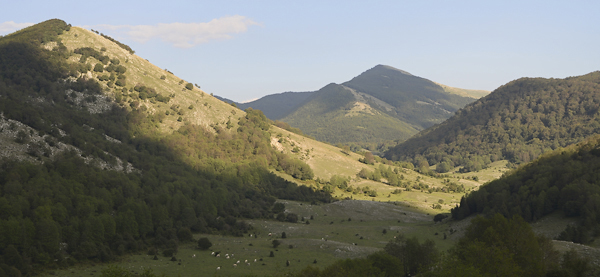
The Cilento hinterland has preserved a wild, original character and has always been a place of retreat—for the local population seeking protection from pirates and invaders, for bandits, for those facing political persecution in their struggle against rulers, and for many animals and plants seeking refuge from hunting, farming, and livestock breeding. Even today, the region between the Vallo di Diano and the coast is difficult to reach via narrow, winding roads and remains largely untouched by the growing tourism along the coast.
 The craggy flanks of the mountains rise bare and bald from the undulating carpet of holm oak, beech, and chestnut forests. This is true for the Alburni Mountains in northern Cilento as well as for the long backbone of Monte Cervati, which, at 1,898 m, is the highest mountain in Cilento and the whole of Campania. Pilgrimage paths lead to a sanctuary of the Madonna near the summit; the name “Madonna delle neve” refers to the fact that quite a bit of snow falls up there in winter. Further hiking trails allow for ascents and crossings. There is also a mountain hut, the Rifugio Monte Cervati, which is open occasionally—it’s best to contact Vienna, the hut warden and mountain guide, in advance by email.
 To explore this area around Monte Cervati more closely, I drove upstream after visiting the Calore Gorge in the Valle dell’Angelo and soon saw the houses of Laurino glowing in the afternoon sun in front of the Monte Motola massif (1,700 m). Finally, I reached Piaggine, where a small road to Rofrano is marked on the map, leading directly into the heart of this wild landscape on the roof of Cilento. In tight bends, the road first gains height rapidly and then follows a high valley. There, a few farm lads are busy rounding up their herd of cows, which are lounging on the road, to drive them back to the pasture.
 The landscape is now becoming more alpine; through dense chestnut and oak forests, I look out onto the grass-covered and thistle-strewn karst slopes. I enjoy the peace and seclusion—or should that be a cause for concern? The road conditions are getting increasingly worse, the asphalt is frequently cracked, and coarse stones, scree, and deep potholes require a weaving course, forcing a mental as well as physical slowing down. Soon the highest point of the road at approx. 1,000 m is passed, the forest thins out, and the Campolongo high valley appears before me, with cattle standing in the lush alpine pasture.
 The path continues south along the valley towards the mountain village of Rofrano, and with every metre downwards, the vegetation becomes more lush; during a photo stop, an intense scent of numerous herbs wafts over from the roadside. In the distance, the steep cliffs of Monte Bulgheria can be seen, and behind them, you can already sense the sea at the Gulf of Policastro. Even though I didn’t have the time (this time) to explore the area extensively on foot, this drive across still provides a fascinating impression of this unique landscape.
More pictures in the Cilento Gallery
Leave a Reply
Want to join the discussion?Feel free to contribute!