
Maori and Their Myths
Chapter 3: A Story Full of Love and Passion
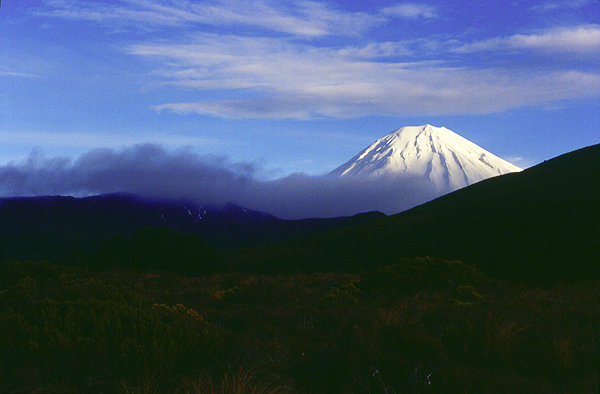
Volcanoes and their fiery forces have always been regarded with respect and fear by many peoples. They are part of a living universe, whose incomprehensible, superhuman powers were sought to be appeased with offerings, or a tapu, a prohibition, demanded appropriate respect. Thus, for a long time, people travelled in awe along the mountains, without ever casting a glance at the sacred peaks. There, the supernatural rulers – Te Roro, Taka and Taunapiki – reign; a disregard for their tapu brought with it the danger of death or a terrible curse.
 The Maori are one of the many cultures that consider volcanoes sacred and place them at the heart of their history and beliefs. For the Tuwharetoa, the mountains are both their matua and tupuna, their parents of the land and divine ancestors, and also the centre of their mana, their spiritual power. “Te ha o Taku Manawa – the breath of my mountain is my heart” – shows not only reverence but also a little pride in living in such close harmony with the land. Creation stories, myths and legends are laid down in artfully carved panels of the meeting houses on the northern slope of Tongariro and in Waihi, on the shore of Lake Taupo, for future generations, thus remaining a living substance of the community. After the culture shock caused by European settlers, Christian religion, integration into a consumer-oriented Western society and the associated weakening of traditional ideas and values, many Maori are now returning to traditional ways of life, authorities and the powerful soul of their faith. But it remains a difficult path!
In one of the most famous legends, which exists in several variations, the mountains are depicted as beings of divine descent but with human traits, experiencing love and suffering, tragedy and humour. At the same time, they establish a close connection with the land by explaining its character and appearance.
 A long time ago, all the great mountains of the North Island were harmoniously gathered in the centre: Tongariro, to its west Taranaki – where the round Tama Lakes are found today – as well as Tauhara and Putauaki, the latter called Mt. Edgecumbe by us – at the site of the present Lake Rotaira. With one exception, the mountain gods were all men and great warriors, standing powerfully with snow-capped peaks and fiery hearts. Only Pihanga was a woman of captivating beauty. This last, gently rounded peak of the Kakaramea mountain range was clothed in richly coloured forest garments. She was revered by all others for her beauty and desired as a wife. The mountains stretched their peaks into the golden sky and adorned themselves with clouds to win her over. The ignited passion eventually led to combative disputes for Pihanga’s favour. At first, there was a long silence, as the mountains gathered strength in their bellies. After a few days, fire erupted with tremendous thunder, and with these weapons, they showered the land with glowing stones. The earth trembled for many days under this battle, from which Tongariro ultimately emerged victorious. Thus, he became the supreme lord of the land and the proud husband of the lovely Pihanga. He received the highest tapu; the eyes of newborns turn towards him and the deceased behold him in all his grandeur on their way to the gathering place of souls. Tongariro now forced his rivals to move on. So the defeated discussed where they should go: “Pihanga belongs to Tongariro, so we should separate.” Tauhara and Putauaki immediately decided to go “to the sea that faces the rising sun”. While they oriented themselves towards the northeast, Taranaki followed the direction of the sunset. So they separated, uprooted themselves and wandered far away. Full of pain, they tearfully bid farewell to Pihanga, who was now Tongariro’s wife.
 The mountains travelled throughout the night. It was a magical pilgrimage during the hours of darkness, the only time when magical beings and mountains can roam. Taranaki moved swiftly and bitterly westwards, reaching the coast before sunrise. There he stands majestically, often looking back at his beloved. If his peak is shrouded in clouds and raindrops fall, these are said to be the tears of a lover. Putauaki and Tauhara simultaneously moved northeast, towards the dawn. At the southern end of the Kaingaroa Plain, after a 160 km journey, Putauaki came to rest and is now a sacred mountain of the Ngati-Awas. Tauhara was the slowest of the defeated suitors. He moved hesitantly and stopped many times to look back at his lost love. Thus, by sunrise, he only made it to the other side of Lake Taupo, across which he forever gazes longingly at the charming Pihanga. The old locations of the mountains now mark several lakes. The mountains also left distinctive traces on their paths. For example, Taranaki gouged a deep wound in the landscape, which is now filled by the Whanganui River.
As this story unfolds in my mind, the landscape before my eyes gains vibrancy, and I feel the longing glances of the main characters from afar. Meanwhile, a blue sky stretches over the North Island, and the radiant sun dispels the last thought of the frosty morning. Yet, the following legend tells of different circumstances, when a dramatic struggle for survival took place on this peak a long time ago.
 After the long journey from his original homeland of Hawaiiki, the island world in the South Seas, the high priest Ngatoro-i-rangi landed with the Arawa canoe in the Bay of Plenty. He soon began exploring and taking possession of the interior for his tribe and travelled south to the volcanoes with his slave Ngauruhoe. He ascended Mt. Tauhara by Lake Taupo, from whose summit he hurled his spear into the lake. This transformed into the trunk of a great Totara tree, which survived for many generations. On his further journey, he saw the snow sparkling on the peaks of Tongariro and felt the desire to ascend to examine the phenomenon, unknown to a South Sea islander, more closely and to perform the sacred rituals for taking possession. During the ascent, they were first hindered by wind and rain, which soon turned into a furious snowstorm. They did not give up and reached the highest peak, but the icy cold was already paralysing their limbs and death by freezing was near. In his despair, Ngatoro-i-rangi, with all his available strength, called upon his priestly sisters for help, asking them to send life-saving fire. They heard the cry for help in distant Hawaiiki and immediately sent aid. The volcano on White Island, hot springs around Rotorua, Waiotapu, Taupo and Tokaanu are visible signs of the path along which the fire approached those seeking help. Finally, it erupted at the summit and saved Ngatoro-i-rangi’s life, but for his slave Ngauruhoe, all help came too late. He took her body and threw it into the crater, which became her fiery grave and has borne her name ever since.
The last story, which took place many generations later in the lineage of Ngatoro-i-rangi, illustrates the transmission of hau, the essence of truth, the soul of knowledge of all spiritual power, from a dying person to a chosen successor.
In the pretty village of Waihi on the shores of Lake Taupo lived the high priest Tai-Pahau, at the advanced age of probably 100 years. He was also the uncle of the tribal chief Te Heuheu Tukino. The latter was in the prime of his life, a powerful and brave warrior. For Tai-Pahau, the time to die was soon approaching, so he lay down in his house, cared for by his youngest daughter.
 Te Heuheu, however, was on a war expedition against the tribes of the lower Whanganui and the West Coast. But he had only reached Poutu on the shore of Lake Rotaira, about twelve miles from Waihi, and had begun his undertaking with no inkling of his uncle’s imminent end. As he camped there, the old man felt his end was near and knew he would not see another sunrise. So he sent a messenger to urgently recall his grandson from the other warriors: “Tell him I am on the verge of death. He will know what I want from him.” So the messenger left the village in great haste. Night had already fallen, and the runner would only reach Te Heuheu’s camp late; the latter, in turn, would not return to his home village before midnight.
The dying Tai-Pahau, meanwhile, waited patiently and would intuitively know when his nephew arrived. He asked to be propped up: “Turn me so that my right side faces the door.” So he sat by the door, like a listener. Moments later, a figure darkened the entrance and quickly stepped in. It was Te Heuheu. In the light of the small fire burning in the middle of the house, he looked at his uncle and immediately knew why he had been sent for. Without a word, he leaned to the priest’s side, opened his own mouth and pressed it firmly over the priest’s right ear. The old man convulsed, emitting three violent sounds as his spirit left his body. Te Heuheu loosened the grip of his teeth around the ear and, with murmured words of separation, pressed his nose against that of the deceased as a sign of farewell. Through this ritual of ngau-taringa, the “biting of the ear”, the supernatural powers and sacred wisdom passed to him.
Te Heuheu did not linger another moment in the house of the dead and returned to his warriors in Poutu. Before sunrise, he reached his companions, who had not noticed his absence. The spirit of his grandfather became Te Heuheu’s guide and protector. On their further war campaign, he foresaw every threat from stronger enemies, and, guided by the wairua, he avoided every danger and defeat.
 Two generations later, it was another chief from this family, Te Heuheu Tukino IV, who, with a far-sighted and wise decision, determined the future of his sacred mountains. Until the middle of the last century, the new immigrants from Europe not only pushed for the ascent of the mountains but also claimed ever larger areas for colonisation. Thus, the chief saw the danger that his ancestors, his spiritual centre, like other areas before, would fall to the Pakeha and be divided up. To prevent this desecration, he consulted with all the other tribal chiefs and persuaded them to make the following decision: the mountain peaks should be gifted to the New Zealand government and thus to all citizens of the country, with the condition that a national park be created from them. This would preserve that land from sale and, under the protection of the highest authorities of the country, be respected and maintained by all people. This gift led to the creation of New Zealand’s first national park in 1887, the fourth worldwide after the beginnings of the national park idea in Yellowstone, USA. From the small core of the peaks of Ruapehu, Ngauruhoe and Tongariro, it has grown to an area of 76,000 hectares today. The park received special honour with its recognition as a World Heritage Site by UNESCO in two categories: as a culturally and historically significant monument and a unique natural landscape.
The hot heart of New Zealand – more about Tongariro National Park:
Chapter 1: Sunrise on the summit of Ngauruhoe
Chapter 2: Māori and their myths
Chapter 3: Spectacular Tongariro: the Crossing and the Northern Circuit
Chapter 4: Oturere and Waihohonu – desolation and abundance of life
Chapter 5: Ruapehu – the sleeping giant or the wolf in sheep’s clothing
Chapter 6: Snow dance on the volcano
Leave a Reply
Want to join the discussion?Feel free to contribute!